


Still think wooden key cards are just for show? Or maybe you’re wondering: Can they really survive the “real world” of guest pockets, spilled drinks, and constant daily use?
It’s a fair question, and one GCSTIMES hears often from hotel managers who perceive them as a design-forward choice, premium in appearance, but potentially limited in durability. To address this concern, performance must be evaluated not by perception, but by measurable standards.
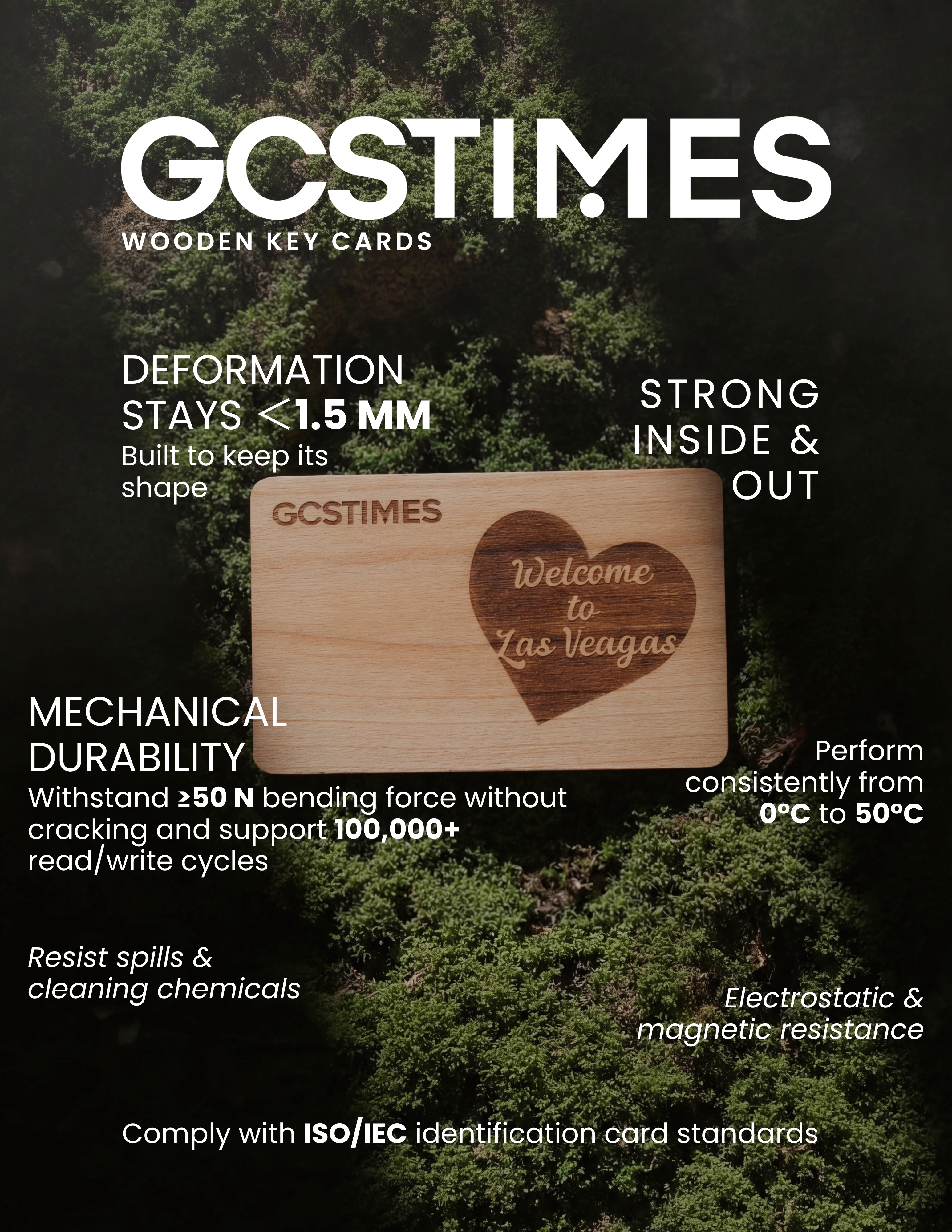
Here’s what we found:
Dimensional Stability
Card deformation remains below 1.5 mm, meeting ISO/IEC 7810 standards. This indicates strong resistance to bending and warping during typical guest use.
Layer Adhesion & Structural Integrity
Multi-layer construction demonstrates sufficient bonding strength, reducing the risk of delamination over time.
Mechanical Durability
Cards are capable of withstanding bending forces of at least 50 N without cracking and can support more than 100,000 read/write cycles, comparable to conventional plastic cards in high-turnover environments.
Environmental Stability
Stable operation is maintained within a temperature range of 0°C to 50°C, covering standard hospitality conditions across most regions.
Chemical Resistance
Exposure to common substances such as alcohol, detergents, and acidic or alkaline solutions does not compromise functionality or visual quality.
Electrostatic and Magnetic Resilience
Cards continue to perform reliably after electrostatic discharge and magnetic exposure testing, ensuring compatibility with existing hotel systems.
All tested parameters comply with ISO/IEC identification card standards and are produced under controlled manufacturing conditions consistent with tested samples.
For hotels, sustainability initiatives must align with operational realities. A product that fails under daily use ultimately increases costs and impacts guest experience. What these results demonstrate is clear: Choosing a more sustainable option no longer means accepting lower durability.


